DivFolio: a Shiny Application for Portfolio Divestment in Green Finance Wealth Management

The problem
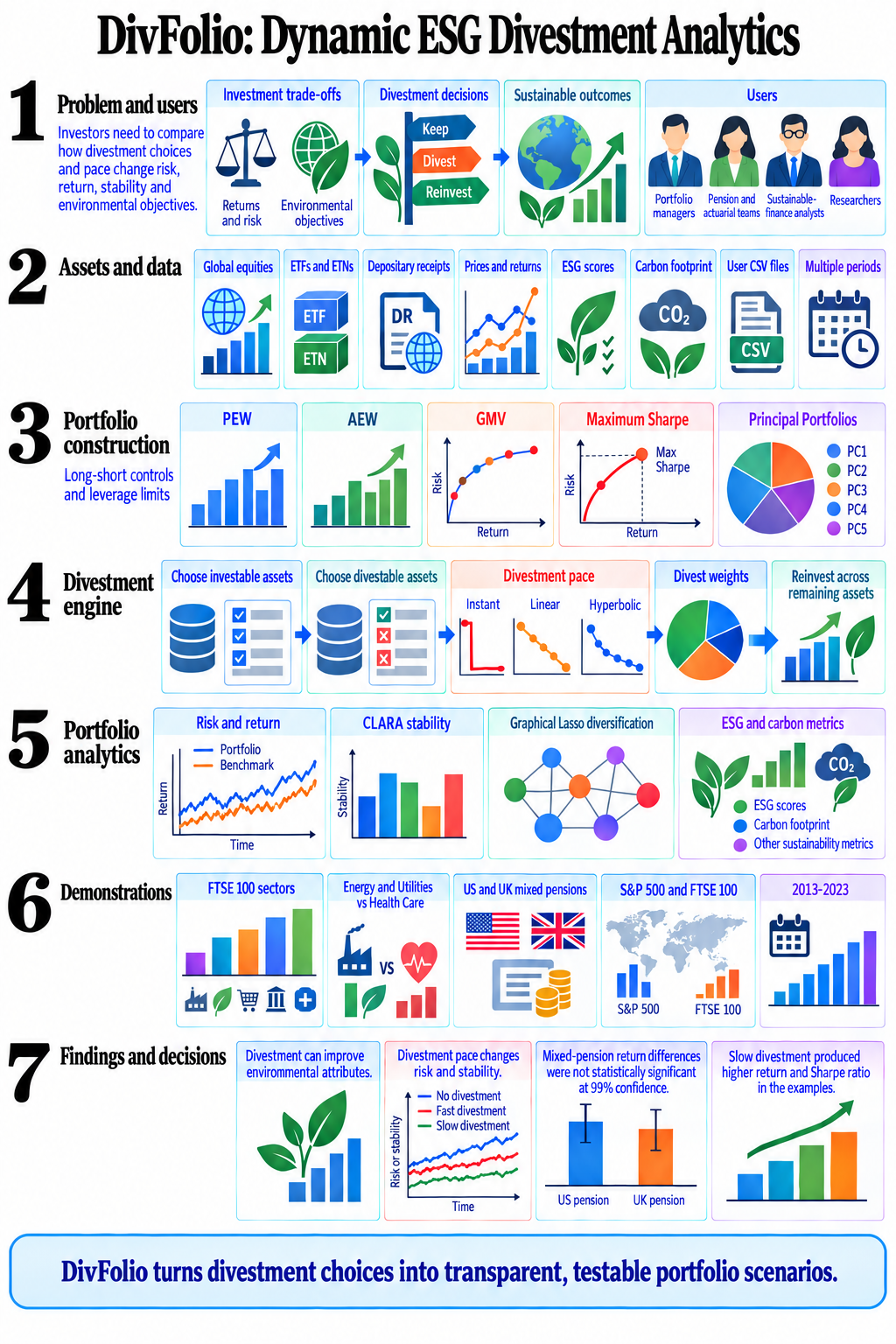
Investors need an accessible way to test how ESG screens, carbon constraints, and divestment schedules alter a portfolio over time. Without an integrated tool, comparing financial performance and climate objectives across many assets and periods is difficult.
Who benefits:
- Portfolio and wealth managers
- Pension, actuarial, and investment-advisory teams
- Sustainable-finance analysts and institutional investors
- Researchers and educators teaching ESG portfolio design
Method
The study develops DivFolio as a freely available R Shiny application with a graphical interface. Its multiperiod engine supports passive and active equal-weighted portfolios, global minimum variance, maximum Sharpe, and principal-portfolio strategies. Users choose investable and divestable assets manually or with ESG criteria, apply instant, linear, or hyperbolic divestment schedules, and reinvest released capital across the remaining assets. The software compares risk and return, uses CLARA clustering to assess stability, and applies Graphical Lasso to examine diversification. Demonstrations cover FTSE 100 sector divestment and environmentally informed mixed pension portfolios in the United States and United Kingdom.
Results
DivFolio brings portfolio construction and divestment analysis into one transparent workflow. The FTSE 100 illustration shows that environmental attributes can improve while divestment choices may change risk, tracking, and stability. In the 2013-2023 US and UK mixed-pension examples, differences in mean returns before and after divestment were not statistically significant at the 99% confidence level. Slow divestment nevertheless produced the highest return and Sharpe ratio among the tested schedules in those examples, illustrating why the pace of divestment should be evaluated rather than treated as a one-time exclusion.