An Improved 1/t Method for Numerical Integration of Ill-Behaved Integrals

The problem
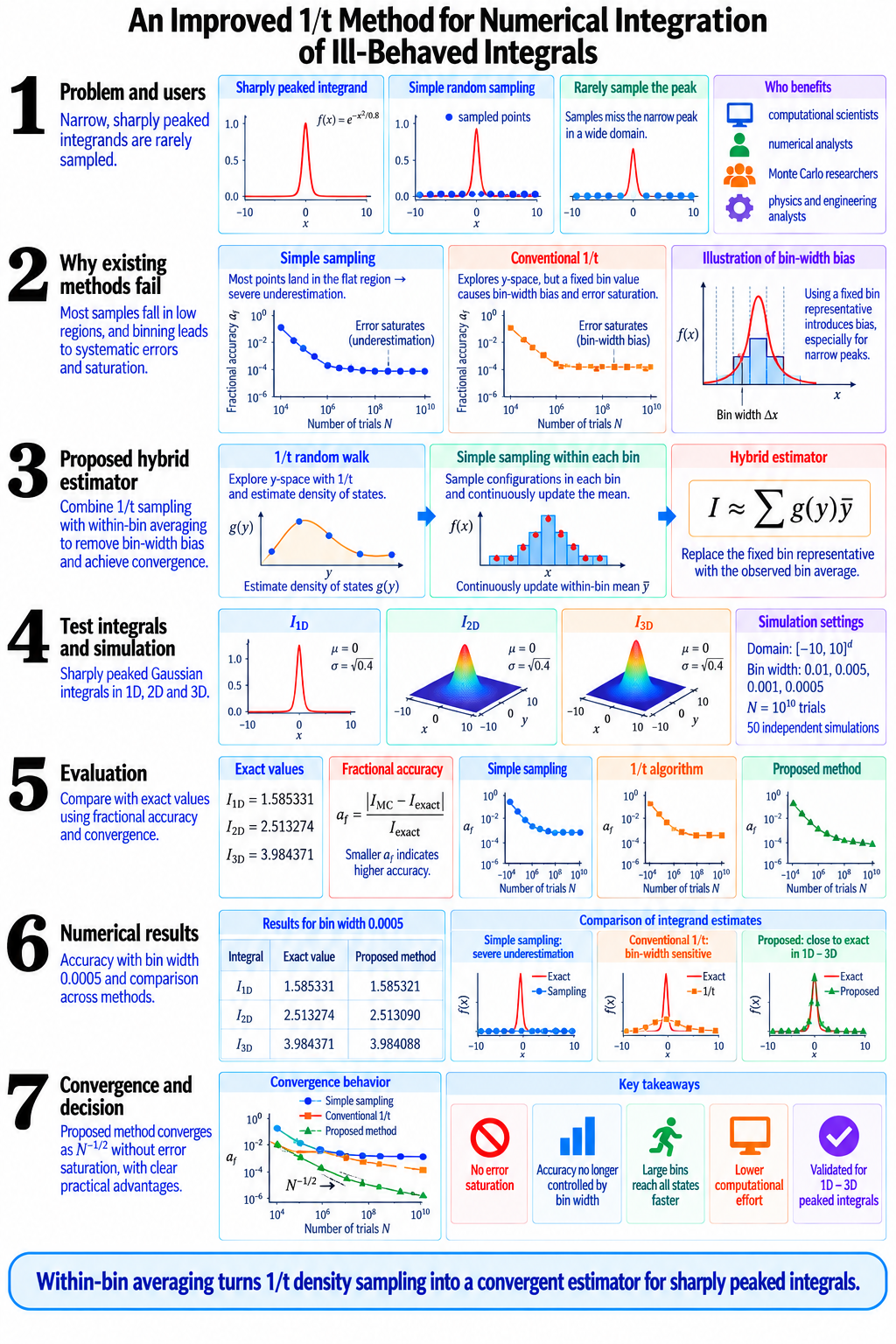
Ordinary Monte Carlo sampling can miss narrow, sharply peaked regions and severely underestimate ill-behaved integrals. The conventional 1/t method samples these regions more effectively, but its fixed representative value within each bin produces bin-width error and eventual error saturation.
Who benefits:
- Computational scientists evaluating difficult multidimensional integrals
- Monte Carlo and density-of-states researchers
- Applied mathematicians studying numerical convergence
- Physics and engineering analysts working with sharply peaked functions
Method
The proposed estimator retains the 1/t random walk for estimating the density of states g(y), but replaces the fixed representative value of each y-space bin with the continuously updated mean of the integrand values actually sampled in that bin. The resulting approximation is a sum of g(y) times the within-bin mean. Tests use sharply peaked Gaussian integrals in one, two, and three dimensions with zero means, standard deviations equal to the square root of 0.4, and the domain [-10, 10] in each dimension. Simple sampling, the conventional 1/t algorithm, and the proposed method are compared over four bin widths, 10^10 trials per run, and 50 independent simulations using exact integral values and fractional accuracy.
Results
Simple sampling severely underestimated the sharply localized integrals, while the conventional 1/t estimates remained sensitive to bin width and eventually reached an error plateau. At bin width 0.0005, the proposed estimates for the one-, two-, and three-dimensional cases were 1.585321, 2.513090, and 3.984088, close to the respective exact values 1.585331, 2.513274, and 3.984371. Its error continued to decrease approximately as N^-1/2 without saturation. Because accuracy was no longer governed by bin width, wider bins could reach all states faster and reduce computational effort.