Obviating the Bin Width Effect of the 1/t Algorithm for Multidimensional Numerical Integration

The problem
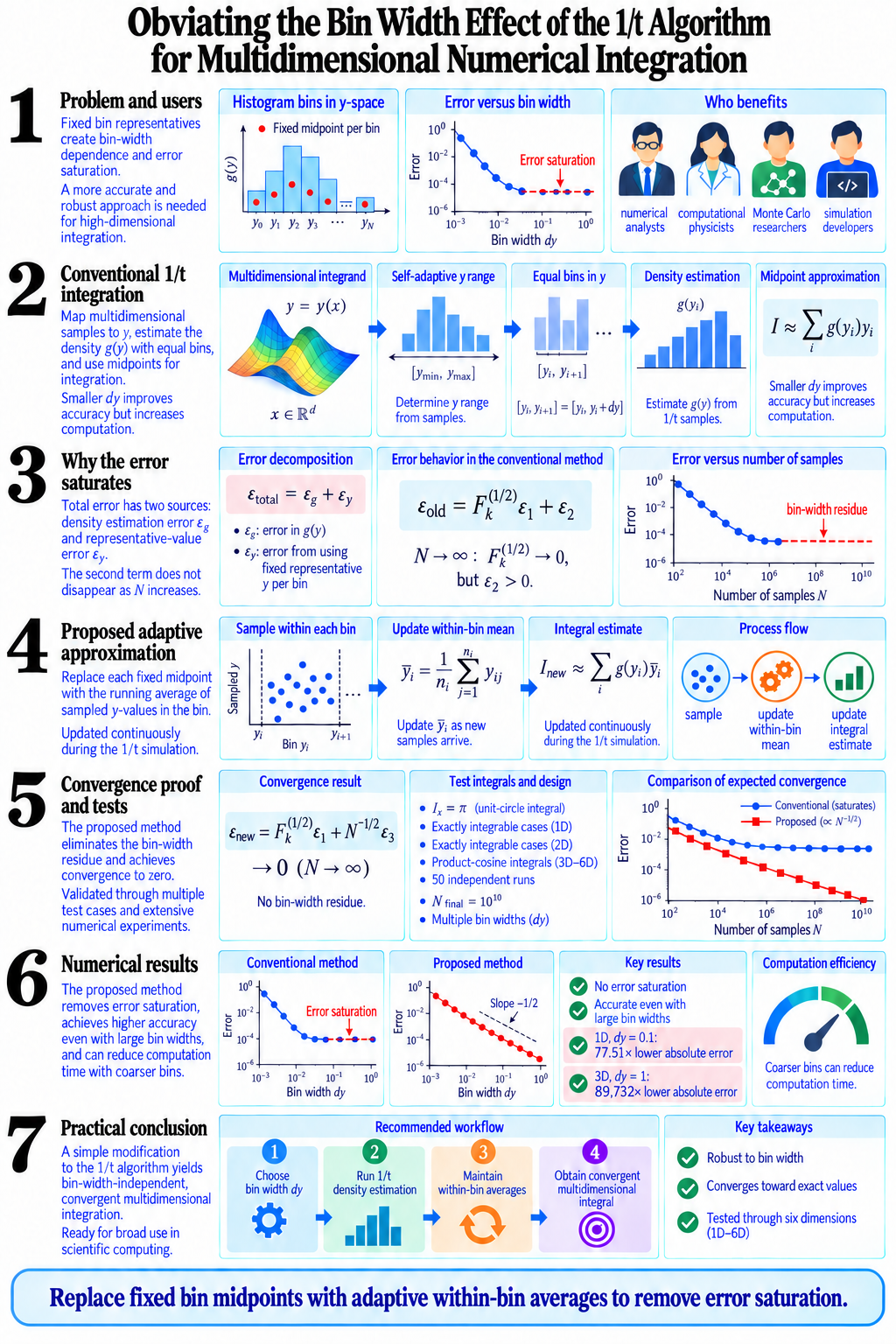
The conventional 1/t Monte Carlo integration algorithm can stop improving because a fixed value represents every point inside a histogram bin. This bin-width effect produces persistent approximation error and prevents reliable convergence in multidimensional integration.
Who benefits:
- Numerical analysts
- Computational physicists and engineers
- Researchers using Monte Carlo integration
- Developers of high-dimensional simulation software
Method
The proposed approximation replaces each fixed bin midpoint with the running average of sampled y-values inside that bin. This average is updated during the 1/t simulation, so the integral estimate improves with the Monte Carlo sample size. The paper decomposes the error to prove that the conventional method retains a nonzero bin-width residue, whereas the new error tends to zero at the N^(-1/2) sampling rate. It then tests exactly integrable cases from one through six dimensions using 50 independent runs and multiple bin widths.
Results
The revised estimates converge toward the exact integral values without error saturation, including when the bins are relatively wide. At dy = 0.1 in the one-dimensional test, the absolute error was 77.51 times lower than for the conventional 1/t estimate; at dy = 1 in the three-dimensional test, it was about 89,732 times lower. The proposed error continued to decrease proportionally to N^(-1/2), enabling coarser bins and substantial computational savings.