A 1/t algorithm with the density of two states for estimating multidimensional integrals

The problem
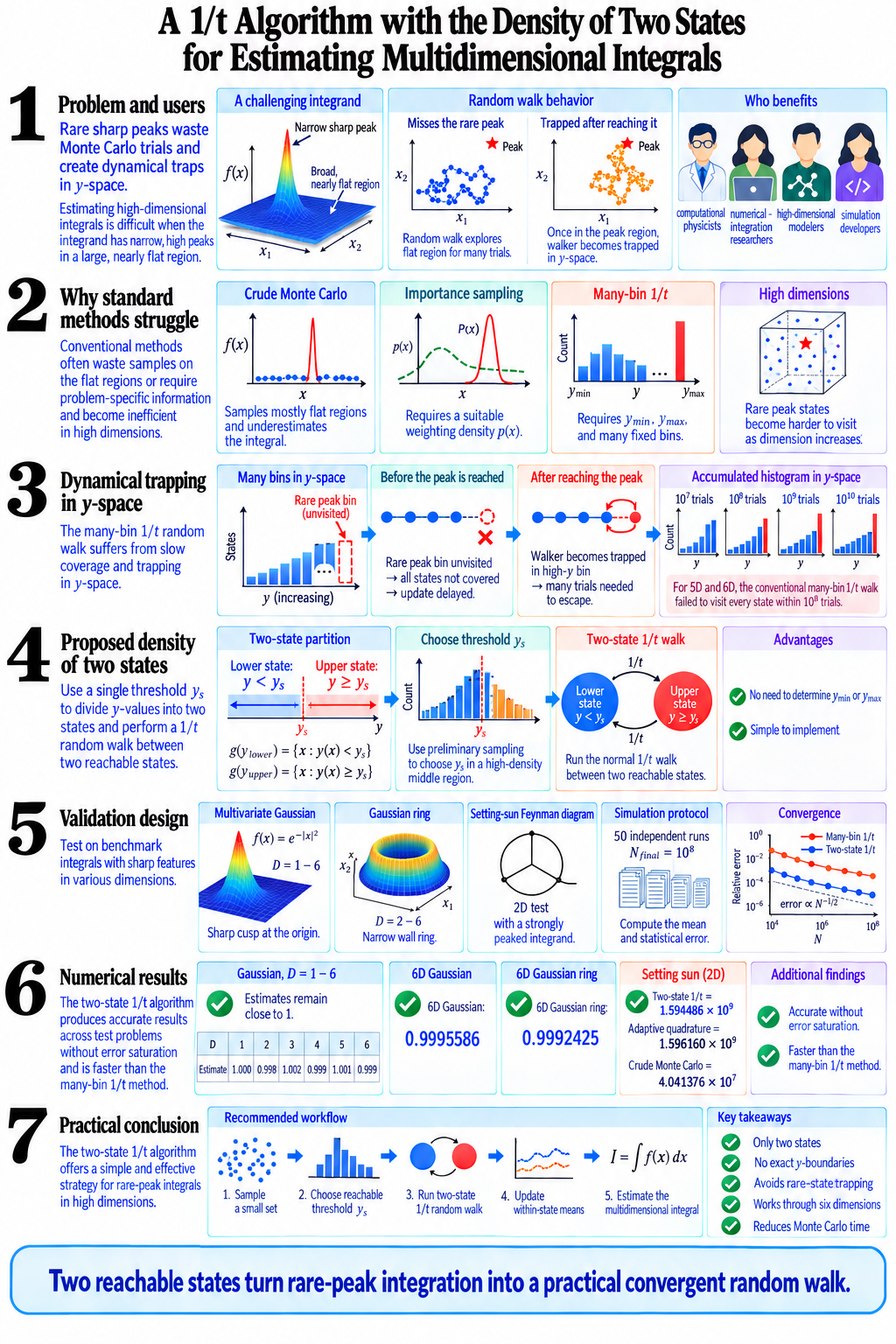
Multidimensional integrals with sharp peaks contain rare regions that are difficult for a random walker to reach and escape. Conventional density-of-states discretization also requires many bins and knowledge of integration boundaries, increasing computation and creating error saturation.
Who benefits:
- Computational physicists
- Numerical-integration researchers
- Scientists evaluating sharply peaked high-dimensional functions
- Simulation developers seeking lower Monte Carlo cost
Method
After a small preliminary sample, the method chooses a reachable threshold y_s in a high-density part of the integrand range and divides y-space into only two states: y < y_s and y >= y_s. A standard 1/t random walk then moves between these states while within-state averages are updated. This avoids fine fixed-width discretization and removes the need to determine y_min and y_max. The study tests multivariate Gaussian integrals in one through six dimensions, Gaussian-ring integrals in two through six dimensions, and a setting-sun Feynman-diagram integral using 50 independent runs with N_final = 10^8.
Results
The two-state method reached accurate values in every Gaussian test through six dimensions, including 0.9995586 for the 6D Gaussian and 0.9992425 for the 6D Gaussian ring, while conventional many-bin 1/t sampling could not visit every state in the 5D and 6D Gaussian tests within 10^8 trials. For the setting-sun example, the estimate 1.594486 x 10^9 closely matched adaptive quadrature at 1.596160 x 10^9, whereas crude Monte Carlo returned only 4.041376 x 10^7. The error decreased at the expected N^(-1/2) rate without saturation.