Wang–Landau Sampling for Estimation of the Reliability of Physical Networks

The problem
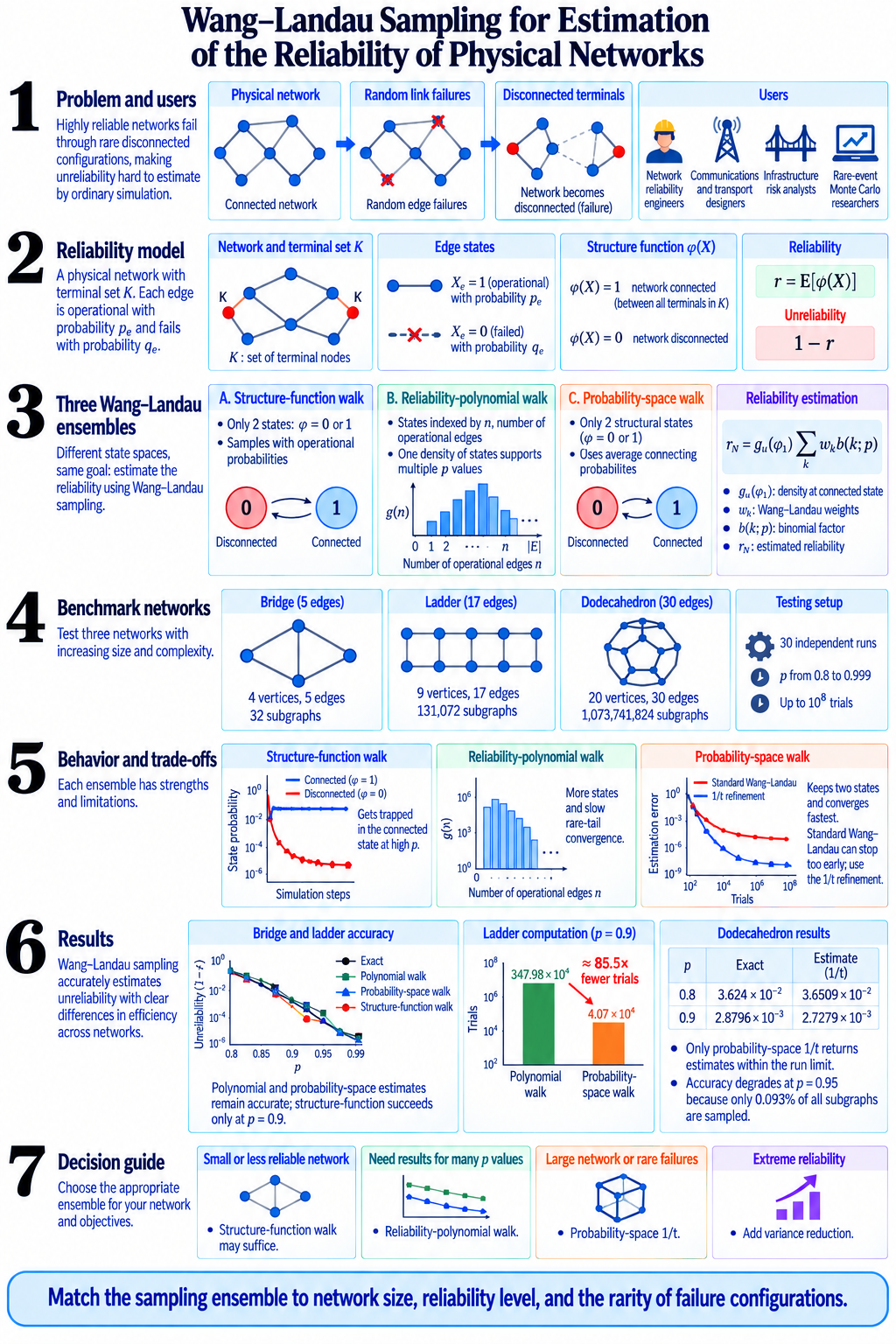
Reliable communication and transportation design requires estimating whether important nodes remain connected after link failures. Standard simulation becomes difficult for large or highly reliable networks because failure configurations are rare and convergence can be extremely slow.
Who benefits:
- Network-reliability engineers
- Communication and transportation-system designers
- Infrastructure risk analysts
- Researchers developing rare-event Monte Carlo methods
Method
The study formulates three Wang–Landau ensembles: a connected/disconnected structure-function walk; a reliability-polynomial walk over the number of operational edges; and a probability-space walk that combines a two-state density with average connection probabilities. Their accuracy and cost are compared on bridge, 17-edge ladder, and 30-edge dodecahedron networks. Tests use edge-operation probabilities from 0.8 to 0.999, 30 independent runs, and up to 10^8 Monte Carlo trials; the dodecahedron probability-space method is also evaluated with the 1/t refinement.
Results
The structure-function walk works only at lower reliability and fails when disconnected configurations become too rare. Reliability-polynomial and probability-space walks are accurate for the bridge and ladder networks, but on the ladder the probability-space approach needs about 4.07 x 10^4 trials versus 347.98 x 10^4 for the polynomial method. For the 2^30-state dodecahedron, only the probability-space 1/t method returns estimates within its run limit: 3.6509 x 10^-2 at p = 0.8 and 2.7279 x 10^-3 at p = 0.9. High variance reduces accuracy at p = 0.95. The method samples just 0.093% of all dodecahedron subgraphs, showing both its efficiency and the need for variance reduction at extreme reliability.