Policy-state gated regime dynamics in European emission allowance futures

The problem
European Union Allowance returns alternate between calm and stressed periods, but it is unclear whether observable policy and market conditions explain transitions between those regimes reliably enough for practical monitoring.
Who benefits:
- Carbon-market policymakers and regulators
- EUA traders and portfolio managers
- Energy-market and climate-risk analysts
- Researchers studying regime-switching financial markets
Method
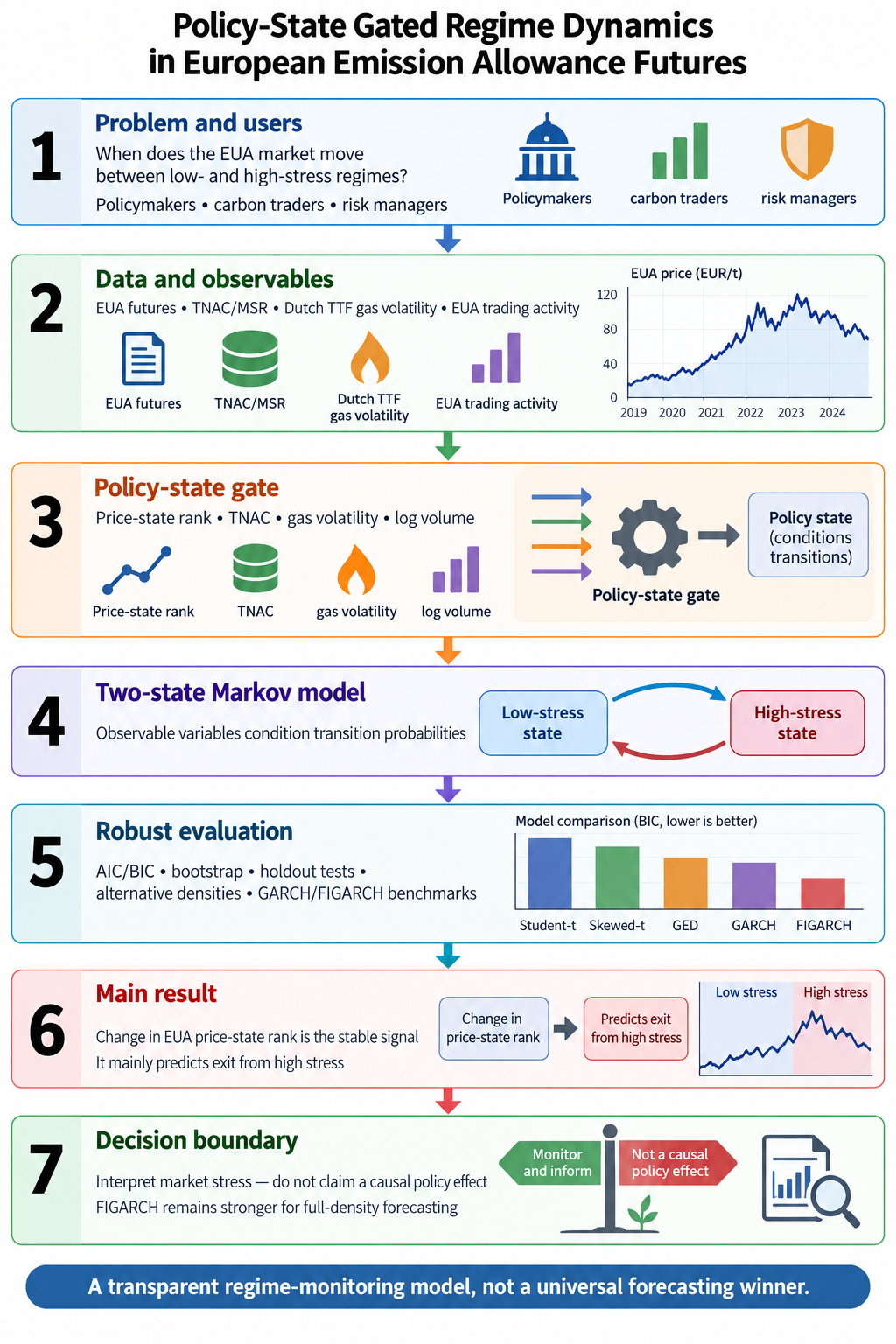
The study combines daily EUA futures prices with official Total Number of Allowances in Circulation records, Dutch gas-market volatility, and allowance trading activity. A policy-state-gated regime-switching return model links these observables to movements between low- and high-volatility states and is compared with alternative transition structures, return distributions, and volatility benchmarks.
Results
Distinct volatility regimes are supported. Changes in the relative position of allowance prices provide the most stable transition signal, mainly for movement out of stressed conditions. Allowance-surplus information, gas volatility, and trading activity add context but not robust independent transition information after trends and model complexity are considered. The framework is useful for interpreting stress, while flexible volatility models remain stronger for forecasting the full return distribution.