Mechanisms for Implementing Fossil Fuel Divestment in Portfolio Management with Impact on Risk, Return and Carbon Reduction

The problem
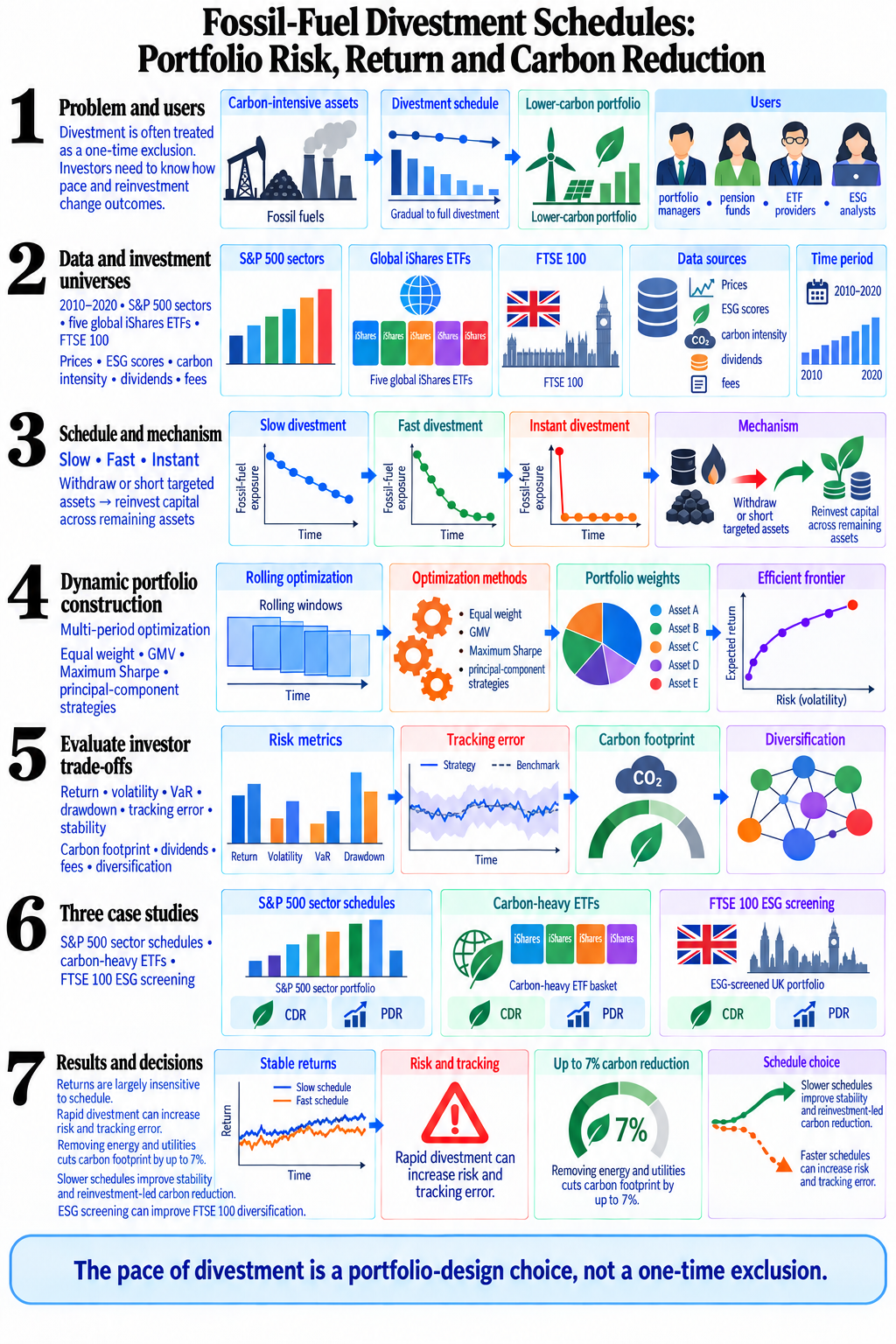
Fossil-fuel divestment is often evaluated as a one-time exclusion, leaving investors without clear evidence about how implementation speed and reinvestment affect portfolio risk, return, stability, and carbon reduction over time.
Who benefits:
- Institutional and retail portfolio managers
- Pension funds and long-horizon asset owners
- ETF providers and investment advisers
- Climate-finance policymakers and ESG analysts
Method
Dynamic multi-period asset-allocation methods evaluate slow, fast, and instantaneous divestment schedules over 2010-2020 for S&P 500 and FTSE 100 portfolios and five global iShares ETFs. The analysis combines sector and ESG screening with withdrawal, shorting, and reinvestment rules, then tracks return, risk, concentration, tracking error, diversification, fees, dividends, and carbon-footprint reduction.
Results
Return profiles are largely insensitive to the schedule, but rapid divestment can increase concentration, risk, and tracking error. Slower schedules provide greater stability and can improve carbon reduction through reinvestment. Removing energy and utilities can reduce carbon footprint by up to 7%, while ETF divestment offers further reductions with fee and dividend trade-offs. ESG-based FTSE 100 screening can improve diversification.