A Stochastic Evolutionary Game Reformulation of the Lux--Marchesi Financial Market Model

The problem
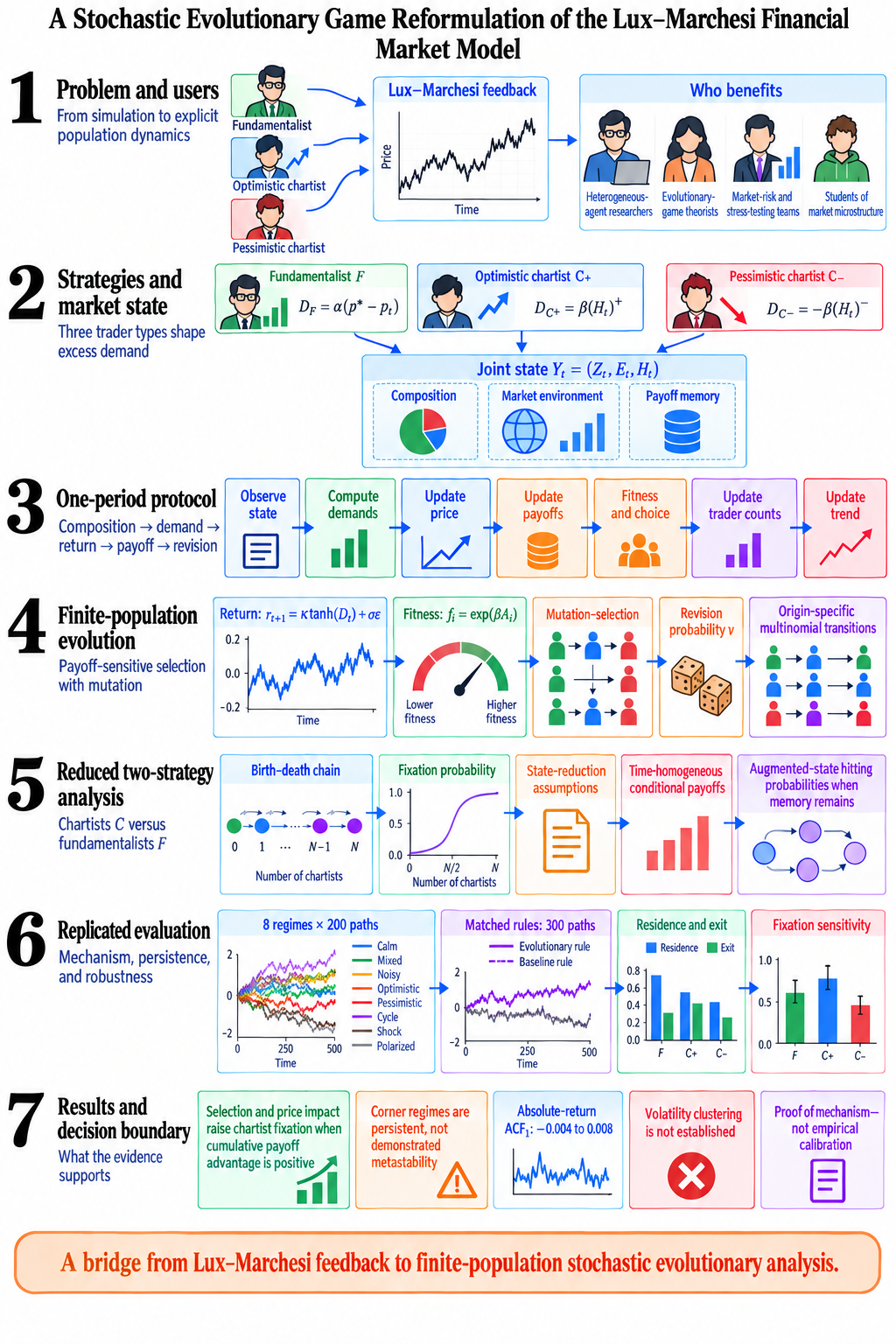
The Lux–Marchesi mechanism explains endogenous financial instability, but its usual simulation framing does not make finite-population transition probabilities, fixation, long-run regime selection, or residence and exit behaviour explicit. The paper builds that analytical bridge while separating genuine model implications from claims that the simulations do not support.
Who benefits:
- Financial-market and behavioural-finance researchers
- Agent-based modelling specialists
- Market-risk and stress-testing teams
- Students of evolutionary game theory and market microstructure
Method
The model couples fundamentalists and optimistic and pessimistic chartists to excess-demand price feedback. Realised returns update payoff memory, attractiveness, and exponential fitness; mutation-selection destination probabilities and origin-specific multinomial revision rows then update the finite population. A reduced chartist-versus-fundamentalist birth-death approximation derives fixation probabilities under stated time-homogeneity and state-reduction assumptions. The numerical study uses 200 replications for each of eight regimes, plus a separate 300-replication matched comparison with a Lux–Marchesi-style switching-intensity rule.
Results
Under the reduced-model assumptions, stronger selection and price impact raise chartist fixation when cumulative chartist payoff advantages are positive. The simulations distinguish calm, noisy, and chartist-dominated regimes, but optimistic and pessimistic corner paths are persistent rather than demonstrated metastable bubbles or crashes. Lag-one absolute-return autocorrelation stays near zero (-0.004 to 0.008), so this parameterisation does not establish volatility clustering. Both update rules admit the designed perturbations in the matched experiment; the evidence is proof of mechanism, not empirical calibration.