Stress-Responsive Lambda Value at Risk with a VIX-Driven Smooth Sigmoid Distortion

The problem
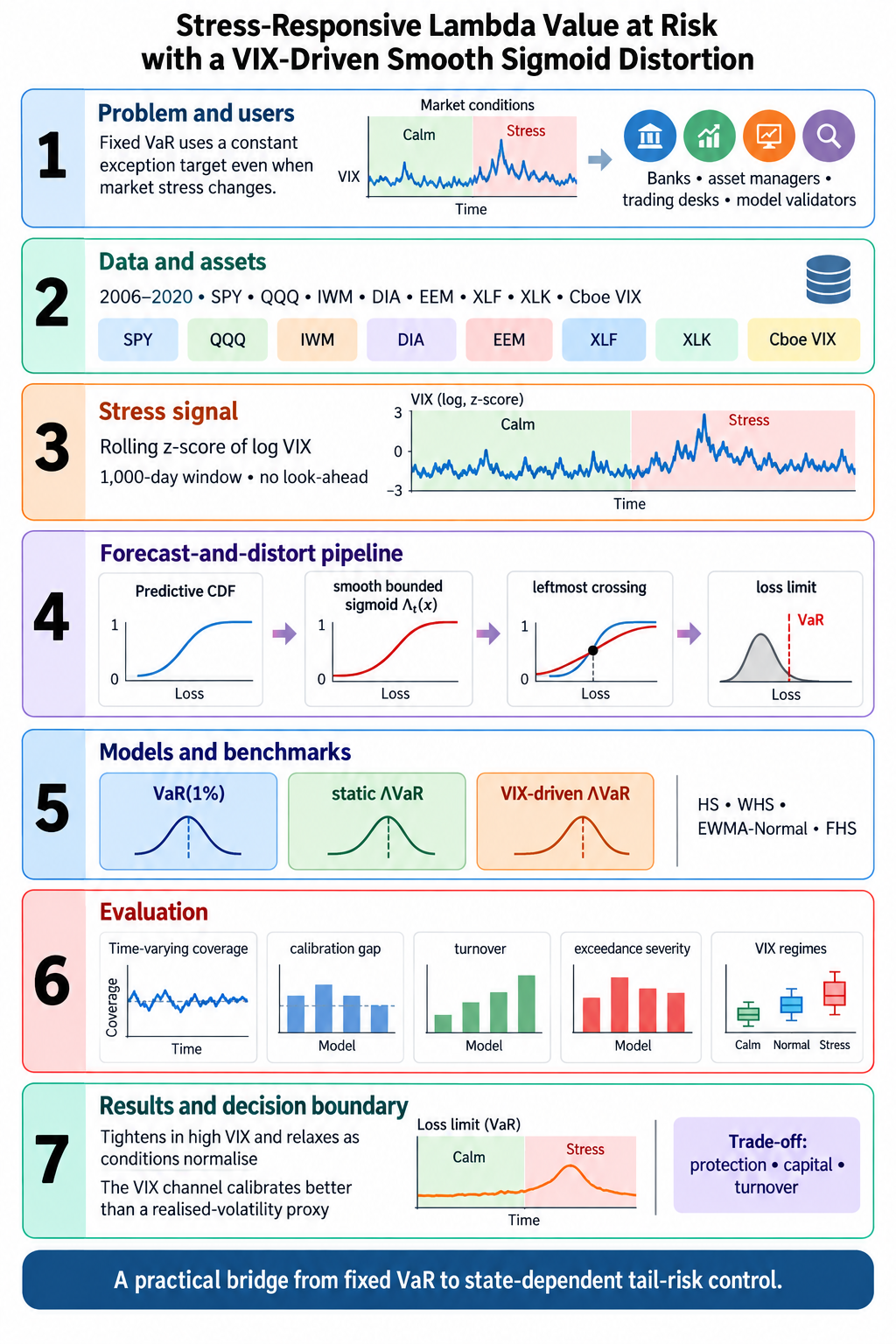
Conventional Value at Risk uses a fixed exception probability even though market stress changes over time. A fixed target may therefore react too slowly in crises and remain unnecessarily restrictive when conditions normalise.
Who benefits:
- Market-risk managers
- Banks, asset managers, and trading desks
- Risk-governance and model-validation teams
- Researchers studying dynamic tail-risk measures
Method
The study models the ΛVaR probability/loss function as a smooth, bounded, monotone sigmoid whose position and steepness depend on a rolling standardised score of log VIX. A modular forecast-and-distort pipeline pairs this mechanism with any predictive return distribution under strict no-look-ahead constraints and evaluates it out of sample against fixed-alpha VaR and time-invariant ΛVaR.
Results
The VIX-driven rule tightens loss limits during stress and relaxes them as conditions normalise, creating interpretable trade-offs among average tightness, turnover, and exceedance severity. The direction of coverage effects remains stable across reasonable constraints, while replacing VIX with realised-volatility stress proxies weakens calibration.