Theory of European Option Underwriting Portfolios

The problem
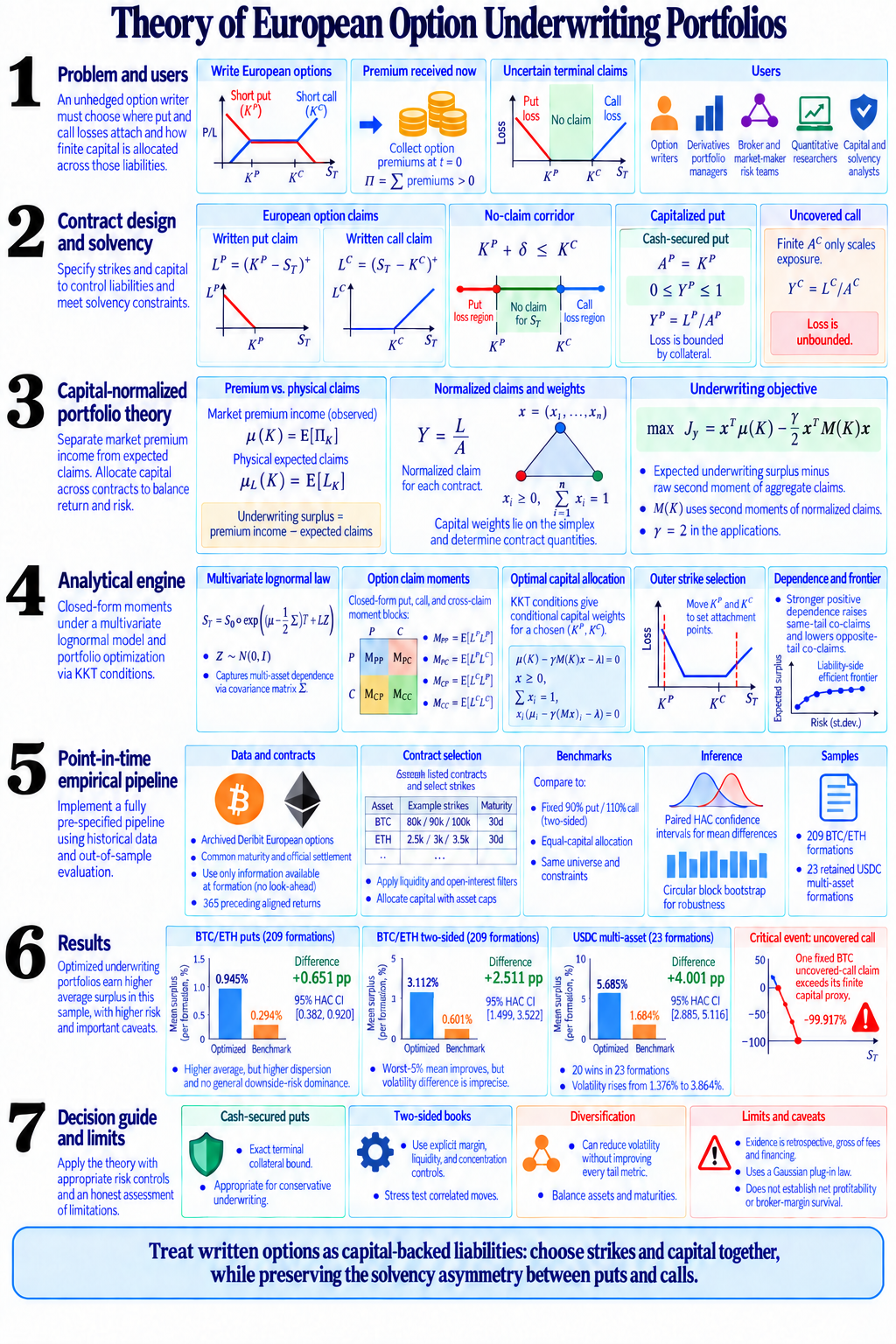
Writing unhedged European options creates a liability-management problem rather than an ordinary investment problem. The writer must decide where downside put claims and upside call claims attach, and how a finite underwriting-capital sleeve should be allocated across them. Cash-secured puts have a genuine terminal claim bound, but an uncovered call remains unbounded even when a finite capital proxy is used to size the position.
Who benefits:
- Option writers and derivatives portfolio managers
- Broker, exchange, and market-maker risk teams
- Quantitative analysts designing strike and capital-allocation policies
- Capital, margin, and solvency analysts
- Researchers studying crypto derivatives and nonlinear portfolio risk
Method
The paper develops a static terminal framework for European cash-settled written puts and calls with a common maturity. It separates observed formation premiums from expected physical claims, divides each claim by a declared capital unit, and maximizes expected underwriting surplus minus a quadratic penalty based on the raw second moment of aggregate normalized claims. Under a multivariate lognormal terminal law, the study derives closed-form put, call, and cross-claim moments, conditional KKT capital allocations, local strike conditions, dependence effects, and a liability-side frontier. The empirical implementation applies staged contract screening and capped allocation to archived Deribit crypto-option formations, using only point-in-time information, 365 preceding aligned returns, fixed 90% put and 110% call benchmarks, paired HAC intervals, and circular block bootstrap diagnostics.
Results
In 209 matched BTC/ETH put formations, the staged 70%-cap policy raises mean gross surplus from 0.294% to 0.945%, a paired difference of 0.651 percentage points with a 95% HAC interval of [0.382, 0.920], but it has higher dispersion and does not establish downside-risk dominance. In the same 209 two-sided formations, mean surplus is 3.112% versus 0.601%, a 2.511-point difference [1.499, 3.522]; the worst-5% mean improves, while the volatility difference remains imprecise. Across 23 retained USDC multi-asset formations, mean surplus is 5.685% versus 1.684%, a 4.001-point difference [2.885, 5.116] with 20 wins, but volatility rises from 1.376% to 3.864%. A realized fixed BTC uncovered-call claim exceeds its finite capital proxy and produces a -99.917% formation surplus. The evidence therefore supports a solvency-aware diagnostic framework, not calibrated tail probabilities, executable net profitability, or broker-margin survival.