State Conditional Boosting for Prospective Early Warning of CFPB Reported Relief Workload

The problem
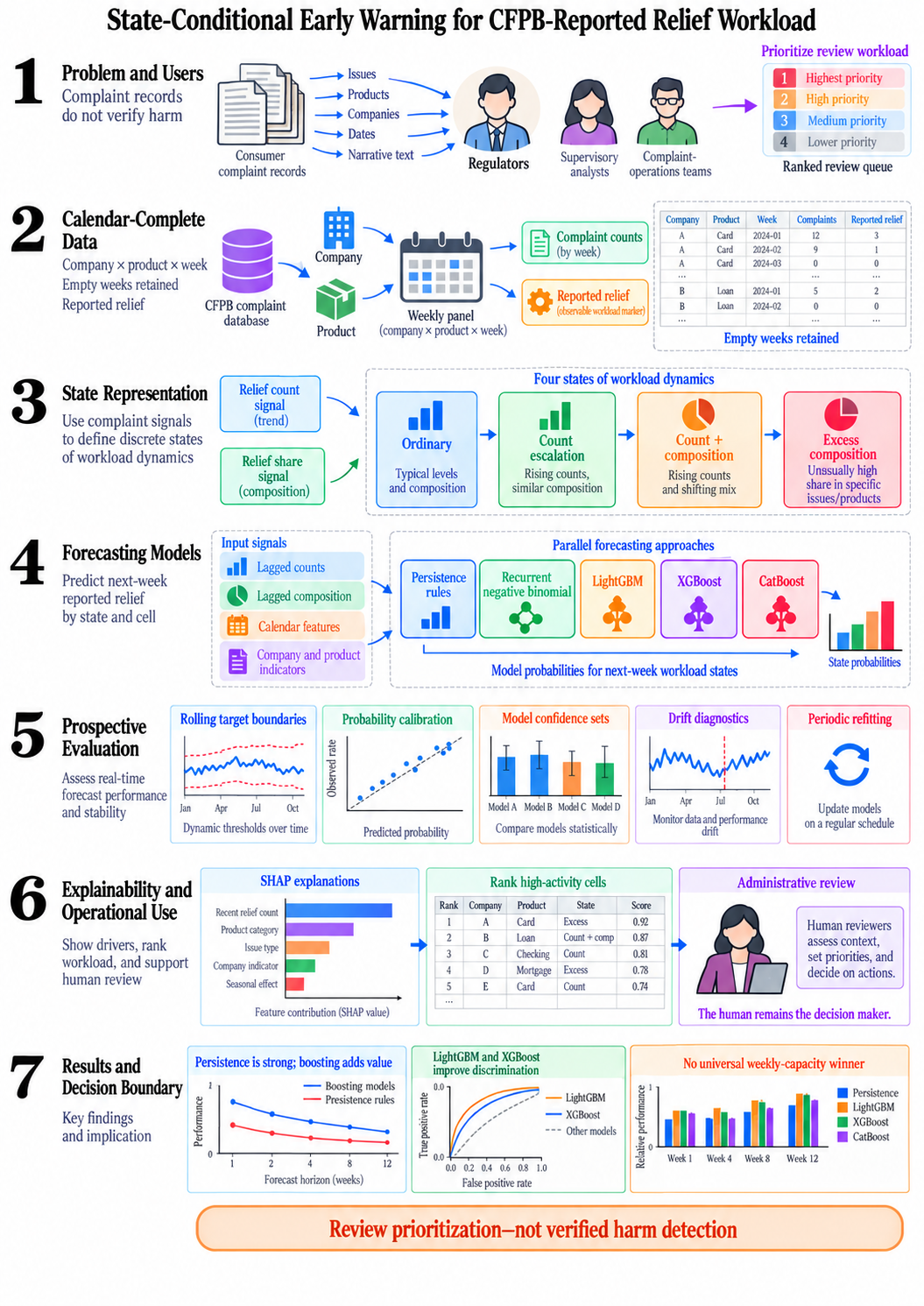
Consumer complaint databases contain useful supervisory signals, but a complaint is not proof of verified consumer harm. The practical task is to identify which established, high-activity company-product cells deserve earlier administrative attention when reported relief workload begins to escalate.
Who benefits:
- Financial regulators
- Supervisory and risk analysts
- Consumer-complaint operations teams
- Researchers developing transparent early-warning systems
Method
The study builds a calendar-complete weekly company-product panel and treats company-reported relief as an observable workload marker. It defines four operational states and compares persistence rules and a recurrent negative-binomial model with matched LightGBM, XGBoost, and CatBoost learners. Evaluation includes calibration, rolling targets, model-confidence sets, drift diagnostics, periodic refitting, and SHAP explanations.
Results
Delayed relief persistence recovers much of the event-ranking signal, while matched boosting retains incremental value. State representation improves pooled excess-relief discrimination for LightGBM and XGBoost but not CatBoost, and capacity comparisons identify no universally superior model. The system supports review prioritisation; it is not a detector of verified consumer harm.