Structural Change Detection in Panel-MIDAS-ARDL Time Series Regression Models: An Application to Firm Values and ESG Scores

The problem
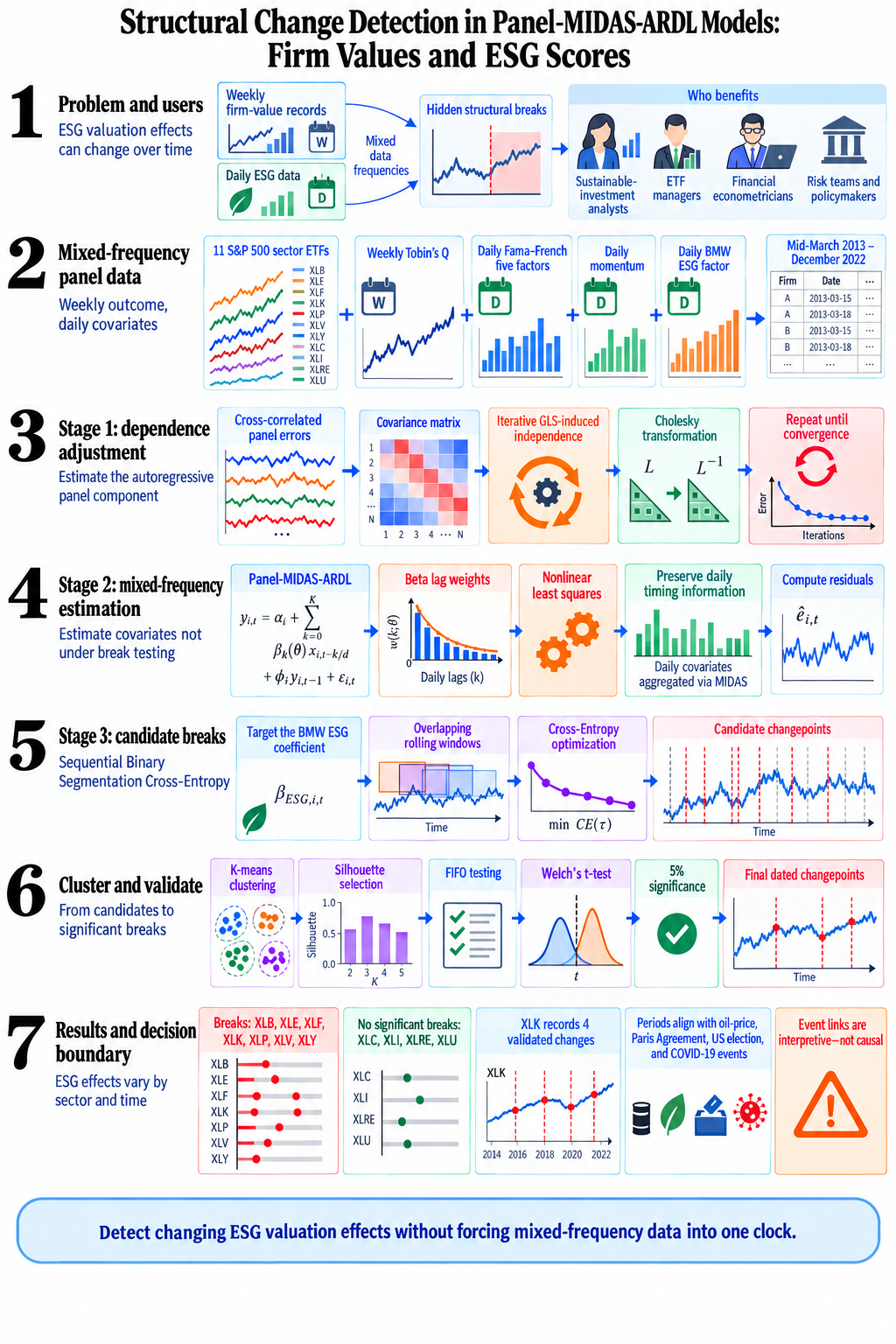
Firm valuation is observed weekly while market and ESG factors are available daily, and the ESG–valuation relationship may shift after economic, political, or regulatory events. Conventional same-frequency or constant-parameter panel models can discard timing information or hide sector-specific structural breaks, producing an average effect that is unreliable for investment and policy interpretation.
Who benefits:
- ESG and sustainable-investment analysts
- ETF managers and equity researchers
- Financial econometricians working with mixed-frequency panels
- Risk teams monitoring changing valuation relationships
Method
The paper develops a Panel-MIDAS-ARDL procedure for cross-sectionally dependent mixed-frequency data. Stage 1 applies iterative GLS-induced independence to the autoregressive component; Stage 2 estimates the remaining daily covariates by nonlinear least squares; Stage 3 applies Sequential Binary Segmentation Cross-Entropy to the ESG coefficient. Overlapping-window candidates are consolidated using K-means with silhouette selection and validated by Welch's t-tests at the 5% level. The application models weekly Tobin's Q for 11 S&P 500 sector ETFs using daily Fama–French factors, momentum, and a Best-Minus-Worst ESG factor from mid-March 2013 through December 2022.
Results
Significant ESG-related breaks appear in materials, energy, financials, information technology, consumer staples, health care, and consumer discretionary ETFs, often near the 2014 oil-price collapse, the 2015 Paris Agreement, the 2016 US election, and the COVID-19 period. Information technology records four validated changes, while communication services, industrials, real estate, and utilities show no significant changes. The results demonstrate a time-varying, sector-heterogeneous ESG valuation effect rather than one stable coefficient; associations with major events are interpretive, not causal identification.