Development of ESG Factors for Enhancing Factor Model in the Thai Stock Market

The problem
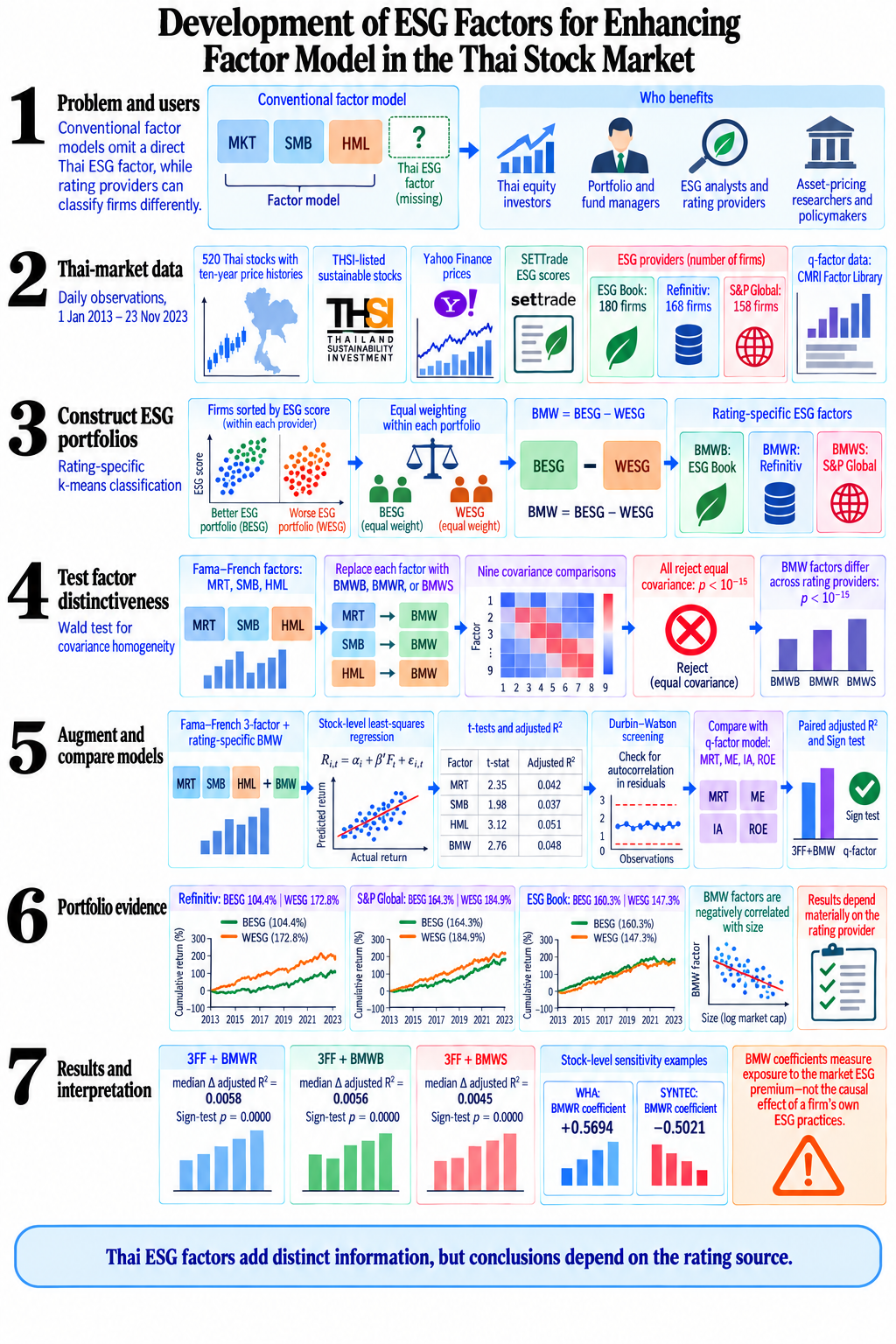
Conventional equity factor models do not explicitly represent ESG characteristics in the Thai market, while rating providers may classify firms differently. Investors therefore need evidence that an ESG factor is distinct from established market factors and improves return explanation.
Who benefits:
- Thai equity investors and portfolio managers
- ESG analysts and sustainability-rating providers
- Asset-pricing researchers
- Fund designers using THSI-listed securities
Method
The study uses daily observations for 520 Thai stocks from January 2013 to November 2023. For ESG Book, Refinitiv, and S&P Global separately, k-means clustering divides firms into equally weighted Better ESG and Worse ESG portfolios, and BMW is their return difference. Wald tests assess covariance distinctiveness before each rating-specific BMW factor is added to a Fama–French specification. Stock-level least-squares regressions, t-tests, adjusted R-squared, Durbin–Watson screening, and a paired sign test compare the augmented models with the q-factor model for THSI-listed stocks.
Results
All nine covariance-replacement tests reject equality at p<10^-15, and BMW factors also differ significantly across rating providers. Relative to the q-factor model, the median adjusted R-squared gains are 0.0058 for BMWR, 0.0056 for BMWB, and 0.0045 for BMWS, with sign-test p-values reported as 0.0000. Portfolio outcomes differ by provider, so the rating source materially affects conclusions. A BMW coefficient measures exposure to the market-wide ESG premium, not the causal effect of a firm's own ESG practices.